


The Athletic Ranks 1970 World Cup as Greatest Tournament in History
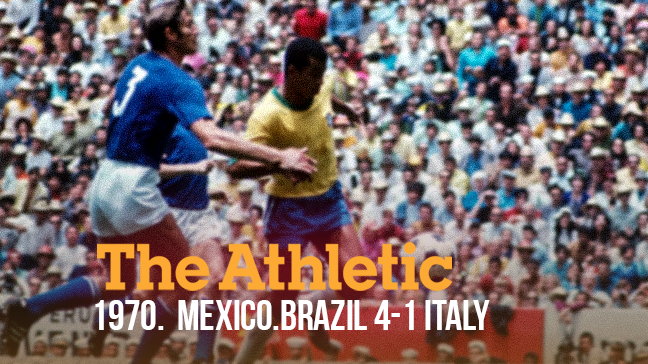
The Athletic has published a ranking of the greatest FIFA World Cup editions ever, placing Mexico 1970 at No. 1 while also including the 2018 and 2026 tournaments in the top 10.
The Athletic has ranked the 1970 FIFA World Cup in Mexico as the greatest edition of the tournament in history, placing Brazil’s legendary triumph ahead of several modern classics and historic football landmarks.
According to reports summarising the ranking, the top three consists of Mexico 1970, Spain 1982 and Mexico 1986. France 1998, Germany 2006, Sweden 1958, Brazil 2014, West Germany 1974, Russia 2018 and the 2026 edition in the United States, Canada and Mexico complete the top 10.
The choice of 1970 as No. 1 is hardly surprising. That tournament has long been treated as a symbol of the “beautiful game”, largely because of Brazil’s team built around Pelé, Jairzinho, Tostão, Rivellino, Gérson and Carlos Alberto. Brazil defeated Italy 4-1 in the final, producing one of the most iconic team performances in World Cup history.
The presence of the 1982 World Cup in second place reflects a different kind of legacy. Italy won the tournament, but the edition is remembered not only for the champions, but also for the drama, tactical variety and the unforgettable Brazil team of Zico, Sócrates, Falcão and Éder, whose defeat to Italy became one of the most discussed matches in football history.
Mexico 1986 completes the top three, largely thanks to Diego Maradona’s defining tournament. Argentina beat West Germany 3-2 in the final, but the edition is most remembered for Maradona’s performances against England and Belgium, which turned the tournament into one of football’s great individual stories.
The ranking also gives a strong position to France 1998, placed fourth. That World Cup combined the rise of a new champion, a powerful host-nation narrative and the final in which Zinedine Zidane scored twice as France beat Brazil 3-0.
Germany 2006 comes fifth, underlining the tournament’s reputation as one of the best-organised modern World Cups. Italy won the title after defeating France on penalties in a final remembered for both Fabio Cannavaro’s leadership and Zidane’s dramatic red card.
Sweden 1958 is sixth, mainly because it introduced the world to Pelé at the age of 17 and produced Brazil’s first World Cup title. Brazil defeated Sweden 5-2 in the final, beginning a dynasty that would define international football for decades.
Brazil 2014 ranks seventh. The tournament produced major storylines, including Germany’s 7-1 semi-final win over Brazil, Lionel Messi leading Argentina to the final and Germany’s extra-time victory through Mario Götze.
West Germany 1974 is eighth. The edition is remembered for the clash between two great football visions: the Netherlands’ Total Football and West Germany’s competitive structure. The hosts won the final 2-1 after the Dutch had scored before West Germany had even touched the ball.
Russia 2018 is ranked ninth. The tournament was won by France, who defeated Croatia 4-2 in the final. It was remembered for late goals, attacking knockout matches, Croatia’s surprise run to the final, Belgium’s strong campaign and France’s emergence as a balanced, explosive champion.
The 2026 World Cup rounds out the top 10. The first 48-team edition and the first World Cup staged across three host nations ended with Spain beating Argentina 1-0 after extra time in the final. Its inclusion shows that, despite debates over expansion, logistics and commercialisation, the tournament left a strong sporting impression.
The ranking is subjective, but it highlights an important pattern in how World Cups are remembered. The best editions are not judged only by the quality of the final or the identity of the champion. They are shaped by iconic teams, unforgettable individual performances, tactical evolution, shock results, national emotion and the wider cultural atmosphere around the tournament.
For football, the list also reinforces how difficult it is for newer tournaments to overtake older mythology. The 1970, 1982 and 1986 World Cups remain powerful because they are attached to stories that define football history: Pelé’s Brazil, Italy’s dramatic survival in Spain and Maradona’s Argentina.
At the same time, the inclusion of 2018 and 2026 shows that recent World Cups can still enter the historical conversation. Modern editions may face more scrutiny over format, politics, broadcasting and commercial pressure, but they can still produce the kind of drama that shapes collective memory.
The Athletic’s ranking therefore works not only as a football list, but as a reminder of what makes the World Cup unique. Every edition is judged through a mix of football quality, emotion, narrative and nostalgia. That is why the debate over the greatest World Cup is never really settled — and why each new tournament has a chance to rewrite the order.
Share

-
 GameBeat Launches Lucky Dice Coins: Roll...GameBeat has released Lucky Dice Coins, ...October 24, 2026
 -
 SOFTSWISS Game Aggregator Marks 11th Ann...The SOFTSWISS Game Aggregator celebrates...October 24, 2026
 -
 BetFury Integrates Swapped Connect to Ma...BetFury, a leading crypto casino, has in...October 23, 2026


