


Singapore High Court blocks enforcement of foreign casino debt
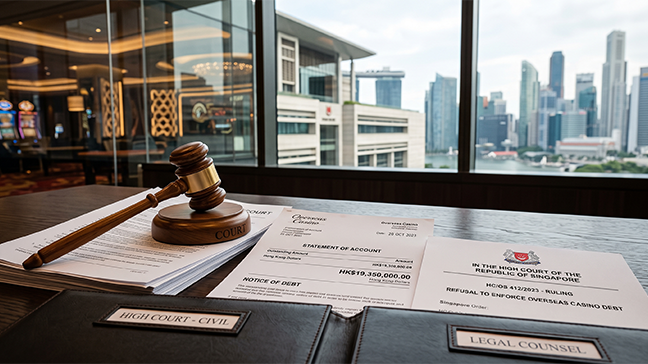
Singapore’s High Court has prevented Venetian Macau from enforcing a Hong Kong judgment for HK$19.35 million in casino debt, ruling that using local courts to recover gambling debts incurred overseas would conflict with Singapore’s public policy.
The General Division of the Singapore High Court has set aside the registration of a Hong Kong judgment obtained by Venetian Macau Limited against gambler Hu Yangning, in a decision that could affect how foreign casinos assess credit risk when customers hold assets in Singapore. The judgment, Venetian Macau Ltd v Hu Yangning [2026] SGHC 180, was issued on September 4.
The dispute arose from gambling credit extended at the Venetian Macau Casino. Hu had patronised the casino between 2011 and 2024 and in November 2023 signed a credit application agreement allowing for up to HK$15 million in credit, together with a promissory note and related authorisation documents. The court found that the credit was provided through casino chips and that the promissory note was inseparable from the arrangement allowing Hu to gamble on credit.
Venetian later sought HK$19.35 million under the promissory note and commenced proceedings in Hong Kong in November 2024. In March 2025, the Hong Kong High Court entered a default judgment requiring Hu to pay HK$19,351,933, interest of 18% per year from October 29, 2024, and legal costs. Venetian then registered that judgment in Singapore in May 2025 and subsequently obtained an order allowing seizure and sale of Hu’s Singapore property.
Hu appealed against the registration, arguing among other things that enforcing the judgment would violate Singapore’s public policy against recovery of gambling debts. Justice Philip Jeyaretnam agreed on that point, finding that Section 5(2) of Singapore’s Civil Law Act embodies a clear policy preventing actions in local courts to recover money won through wagering.
The court rejected the argument that the position should be different simply because Venetian was attempting to enforce a foreign judgment rather than sue directly in Singapore. Jeyaretnam held that allowing a foreign casino to recover the debt through judgment registration would effectively undermine the same policy that prevents gambling debts from being pursued directly before Singapore courts.
The decision therefore set aside the Singapore registration order under the Reciprocal Enforcement of Foreign Judgments Act (REFJA). However, the court rejected several of Hu’s other arguments. It found no sufficient basis to set aside the judgment on fraud or jurisdiction grounds and also concluded that the available evidence supported an inference that she had received actual notice of the Hong Kong proceedings.
Importantly, the ruling does not cancel the Hong Kong judgment or declare the underlying debt invalid everywhere. Rather, it prevents Venetian Macau from using Singapore’s courts to enforce that judgment. The High Court expressly noted that casinos may still attempt to enforce their causes of action in other jurisdictions where local law permits recovery.
The judgment could nevertheless have broader commercial consequences for casino operators across Asia. Casinos extending substantial credit to VIP customers may need to place greater emphasis on where a player’s assets are located and whether gambling-related judgments can ultimately be recognised there. For operators dealing with customers whose recoverable assets are concentrated in Singapore, the ruling increases the legal risk associated with unsecured casino credit.
Share

-
 South Africa’s Content Market Is Crowded...South Africa’s gambling market continues...October 22, 2026
 -
 SOFTSWISS Group CSO Wins Top Global CISO...SOFTSWISS Group Chief Security Officer E...October 22, 2026
 -
 BF Games Puts Juicy Booster in the Spotl...BF Games has showcased Juicy Booster thr...October 22, 2026


