


India’s Supreme Court moves toward final hearings on nationwide online gaming ban
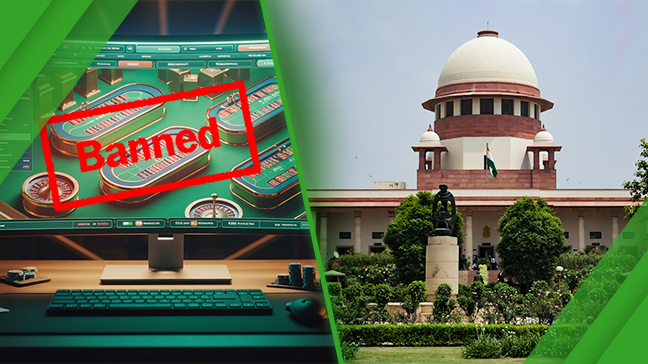
India’s Supreme Court has agreed to move a series of constitutional challenges to the country’s nationwide ban on online real-money gaming toward final hearings, setting up a potentially decisive ruling for an industry that has faced sweeping restrictions since May.
The Supreme Court of India has agreed to proceed to final hearings on a batch of petitions challenging the Promotion and Regulation of Online Gaming Act, 2025, which prohibits online real-money games across the country regardless of whether their outcome depends on skill, chance or a combination of both. The law entered into force on May 1, 2026.
During the August 5 hearing, a bench led by Chief Justice Surya Kant and Justice Joymalya Bagchi instructed lawyers representing the parties, including Solicitor General Tushar Mehta for the central government, to complete their pleadings before the case proceeds to substantive final consideration. The latest order moves the constitutional dispute closer to a ruling, although the court has not yet decided whether the prohibition itself is valid.
The legislation defines an “online money game” broadly as a game played after a user pays a fee, deposits money or provides another stake in expectation of monetary or equivalent rewards. Crucially, the definition applies irrespective of whether the game is based on skill or chance, while recognised esports without wagering are excluded. The Act prohibits the offering and facilitation of online money games, advertising connected to them and financial transactions used to fund participation.
This distinction is central to the legal challenge. Petitioners argue that applying a complete prohibition to skill-based products such as rummy and poker may violate Article 19(1)(g) of the Indian Constitution, which protects the right to practise a profession or conduct a lawful trade or business, subject to reasonable restrictions. Industry challengers have maintained that treating games traditionally recognised as involving skill in the same way as gambling based purely on chance has effectively eliminated a previously legitimate business sector.
The challenges were originally brought before the Delhi, Karnataka and Madhya Pradesh high courts. In September 2025, the Supreme Court transferred the cases to itself following a request from the central government, allowing the constitutional questions surrounding the national legislation to be considered together rather than producing potentially conflicting judgments in different jurisdictions.
The government, meanwhile, has defended the restrictive approach on consumer-protection, public-health and financial-crime grounds. The legislation itself cites addiction, financial losses, risks to younger and economically vulnerable users, aggressive marketing and concerns involving fraud, money laundering, tax evasion and, in some cases, terrorist financing as reasons for establishing a national framework.
Alongside the industry challenges, the Supreme Court will also consider a public interest litigation brought by the Centre for Accountability and Systemic Change. The organisation is seeking stronger action against gambling and betting services that it claims continue to operate while presenting themselves as social games or esports products. Its lawyer told the court that a list of around 2,000 allegedly active gaming applications had previously been submitted to both the authorities and the bench.
India’s regulatory environment has already changed substantially since the Act was approved. The government notified the Promotion and Regulation of Online Gaming Rules in April 2026 and established the Online Gaming Authority of India, with the new regime becoming operational from May 1. The framework supports esports and qualifying social games while maintaining the prohibition on online money gaming.
The forthcoming hearings could therefore determine more than the future of individual gaming companies. The Supreme Court will effectively be asked to clarify how far the central government can go in imposing a uniform nationwide prohibition on real-money gaming and whether the traditional legal distinction between games of skill and games of chance retains constitutional significance in the digital market.
A ruling upholding the legislation would reinforce one of the world’s most restrictive national approaches to online real-money gaming. A successful challenge, however, could force lawmakers to reconsider the blanket prohibition and potentially reopen the debate over whether regulated skill-based gaming should be treated separately. Until the Supreme Court delivers its final judgment, the existing national ban remains in force.
Share

-
 SBC Summit returns to Lisbon for a recor...SBC Summit, the betting and iGaming indu...September 24, 2026
 -
 GR8_TECH Named VIP Lounge Sponsor at iGa...AffPapa is pleased to announce that GR8_...September 24, 2026
 -
 ElCasino Expands Its Live Portfolio with...Two new titles bring contrasting formats...September 24, 2026


