


Brazil Supreme Court suspends landmark gambling case after Fux backs 1941 ban
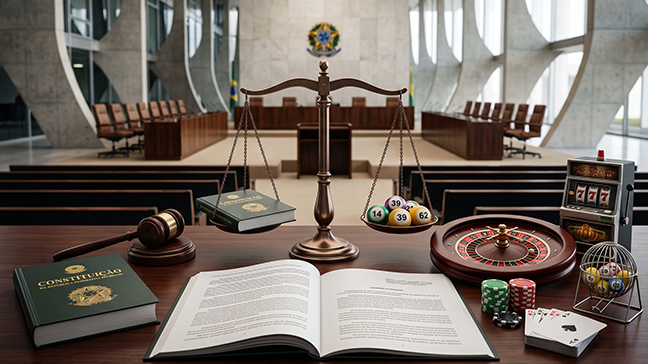
Brazil’s Supreme Federal Court has suspended its review of Extraordinary Appeal RE 966177 after Justice Flávio Dino requested more time to examine the case. The proceedings could determine whether the country’s decades-old criminal prohibition on games of chance, including casino-style gaming, slot machines and bingo, remains compatible with the 1988 Constitution.
Brazil’s Supreme Federal Court (STF) has temporarily suspended a closely watched case concerning the legal status of games of chance after resuming proceedings on August 5 and 6. Extraordinary Appeal RE 966177, classified as General Repercussion Theme 924, examines whether Article 50 of Brazil’s 1941 Criminal Misdemeanours Law remains valid under the Constitution adopted in 1988.
The provision makes it a criminal misdemeanour to establish or operate games of chance in a public place or a venue accessible to the public. It has historically provided the legal basis for action against activities including slot machines, bingo and other unauthorised gambling operations. The case does not itself create a licensing system for casinos or bingo; instead, the Court is deciding whether the existing criminal prohibition continues to have constitutional force.
The dispute originates from Rio Grande do Sul, where a lower court overturned the conviction of a man who had operated three slot machines in a bar in São Leopoldo. The state court concluded that the 1941 prohibition had not been received by the 1988 Constitution, citing principles including individual freedom and free enterprise. The Public Prosecutor’s Office of Rio Grande do Sul appealed that decision to the STF.
Justice Luiz Fux, the rapporteur in the case, became the first member of the Court to vote when proceedings resumed. Fux supported the continued validity of Article 50 and proposed a binding thesis stating that the criminal misdemeanour of operating games of chance was received by the 1988 Constitution. If his position ultimately commands a majority, the legal basis for prohibiting unauthorised land-based gambling would remain intact.
Fux argued that constitutional protections for individual freedom and free enterprise do not prevent the state from restricting activities considered harmful to society. He also highlighted the potential for gambling products to exploit addictive behaviour and referred to social consequences including indebtedness and financial harm to households.
The case was interrupted on August 6 when Justice Flávio Dino requested additional time for analysis. Dino indicated that he broadly agreed with Fux that the prohibition on traditional games of chance remains constitutionally valid, but questioned whether the Court should establish a final legal thesis without also addressing Brazil’s rapidly expanding online betting market.
Dino argued that the Court should consider RE 966177 together with other proceedings dealing with the federal betting framework, including constitutional challenges to Law 14.790/2023. Brazil has already established a regulated federal market for authorised fixed-odds betting, creating an increasingly visible contrast between legal online betting and the continuing prohibition applied to many traditional gambling products. The STF plenary agreed to postpone the conclusion of RE 966177 while the relationship between those different legal regimes is examined.
The eventual ruling will carry consequences well beyond the original slot-machine case. According to the STF, at least 2,728 proceedings throughout the Brazilian judicial system are currently suspended pending a definitive decision under the Court’s general-repercussion mechanism. The legal thesis eventually adopted by the Supreme Court will therefore guide lower courts facing comparable disputes.
For Brazil’s gambling industry, however, the distinction between judicial and legislative reform remains important. A decision that Article 50 is unconstitutional would weaken the existing legal foundation for criminalising certain games of chance, but it would not automatically establish a regulated commercial market for casinos or bingo. Conversely, a decision confirming the provision would preserve the prohibition unless Congress subsequently changes federal legislation.
No new date has yet been set for the STF to resume the judgment. The pause leaves Brazil with two very different gambling regimes operating side by side: federally regulated fixed-odds betting on one hand and a decades-old prohibition covering many traditional games of chance on the other. The Court’s eventual ruling could provide greater constitutional clarity, but the creation of a fully regulated casino or bingo market would still require a broader political and legislative decision.
Share

-
 3 Weeks Until Sports Betting West Africa...As the 3-week countdown begins, the foca...September 26, 2026
 -
 Colombia Gambling Contributions to Subsi...Colombia’s gambling regulator Coljuegos ...September 26, 2026
 -
 South Korea Halts 236 Illegal Gambling S...South Korean authorities have disrupted ...September 26, 2026


