


Argentina Faces Growing Backlash as Petition and Refereeing Row Shake World Cup Run
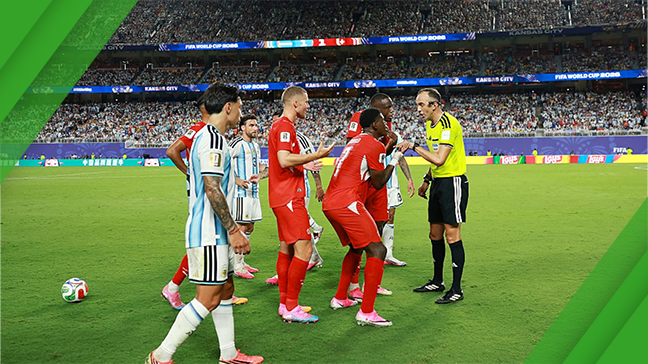
A reported petition with more than three million signatures, Egypt’s anger after its Round of 16 defeat and Switzerland’s frustration over Breel Embolo’s red card have turned Argentina’s path to the World Cup semi-finals into one of the tournament’s biggest controversies.
Argentina’s run at the 2026 FIFA World Cup has moved beyond the pitch and into a wider debate over refereeing, VAR and the influence of superstar narratives at major tournaments. After controversial knockout wins over Egypt and Switzerland, criticism of the defending champions’ path has intensified across fan platforms, media coverage and national team reactions.
A petition demanding that Argentina be disqualified from the World Cup has reportedly passed more than three million signatures. The campaign reflects growing frustration among fans who believe that key decisions in Argentina’s knockout matches have repeatedly gone in favour of Lionel Scaloni’s team. While such petitions do not have direct legal or sporting force, the scale of public reaction shows how quickly refereeing disputes can become a reputational issue for FIFA.
The first major flashpoint came in the Round of 16, when Argentina beat Egypt 3-2 after a dramatic late comeback. Egypt had led 2-0 before Argentina scored three times in the closing stages. But the result was immediately overshadowed by Egypt’s complaints over several decisions, including a disallowed goal by Mostafa Zico and penalty appeals involving Hamdi Fathy and Mohamed Salah.
Egypt head coach Hossam Hassan strongly criticised the match officials and suggested that outside pressure may have influenced the atmosphere around the game. He said that perhaps there was a desire to keep Lionel Messi in the tournament, a statement that quickly amplified the controversy around Argentina’s victory.
The Egyptian Football Association also filed a complaint with FIFA, calling for an investigation into referee François Letexier, the VAR team and what it described as “double standards” in the handling of key incidents. The federation demanded that the officials involved be removed from the tournament if serious mistakes were confirmed.
The debate then widened after Argentina’s 3-1 extra-time win over Switzerland in the quarter-finals. Switzerland had equalised through Dan Ndoye and appeared to be building momentum before Breel Embolo was sent off in the 72nd minute. The decision came after a VAR review: referee João Pinheiro initially booked Leandro Paredes, but the card was later transferred to Embolo for simulation under the mistaken identity protocol.
For Switzerland, the red card became the turning point of the match. Down to ten men, Murat Yakin’s side spent the rest of normal time defending and eventually conceded twice in extra time, with Julián Álvarez and Lautaro Martínez sending Argentina into the semi-finals against England.
Swiss players and staff reacted with anger, arguing that the decision changed the course of the match. Embolo, who had already been booked earlier, was visibly emotional after the dismissal, while Yakin described the situation as extremely difficult to accept. Supporters also questioned whether VAR should be used to create a second yellow card situation when the initial decision on the field had gone in the opposite direction.
At the same time, rules analysts have noted that simulation is a cautionable offence under IFAB Law 12. Under the mistaken identity procedure, if VAR determines that the wrong player has been cautioned, the disciplinary action can be assigned to the correct player. This means that the decision may be defensible under the laws of the game, even if its impact on the match was enormous and deeply controversial.
The larger issue for FIFA is not only whether each individual call can be justified by the rulebook. The problem is trust. When Egypt, Switzerland and millions of fans interpret successive Argentina matches through the same lens of perceived advantage, the tournament’s credibility becomes part of the story.
Argentina remains in the competition and is preparing for a high-profile semi-final against England. But the defending champions now carry more than sporting pressure. Their World Cup campaign has become a test of how FIFA explains VAR decisions, manages public outrage and protects the perception of fairness in the most watched football event in the world.
Share

-
 ONLYPLAY Had Outgrown ONLYPLAY: The Stor...After six years of growth, ONLYPLAY has ...September 16, 2026
 -
 Meet GR8_TECH's New Champions at SBC Sum...GR8_TECH is bringing a strengthened lead...September 16, 2026
 -
 African Gaming Industry to Get Continent...The African Lotteries & Gaming Associati...September 16, 2026


