


Uganda Launches Five-Year NLGRB Strategy to Link Gaming Oversight With Revenue and Development
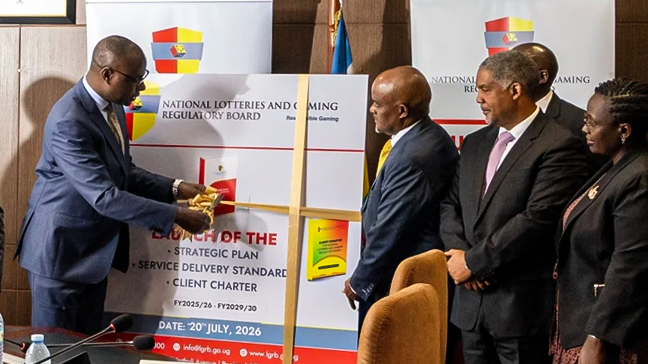
Uganda has launched the National Lotteries and Gaming Regulatory Board’s Strategic Plan for FY2025/26 to FY2029/30, alongside a new Client Charter and Service Delivery Standards, setting a five-year agenda for stronger compliance, responsible gaming and revenue assurance.
Uganda has launched a new five-year strategic roadmap for the National Lotteries and Gaming Regulatory Board, marking a significant step in the country’s effort to modernise gaming regulation and connect sector oversight more directly with national development goals.
The Strategic Plan for FY2025/26 to FY2029/30 was launched alongside a new Client Charter and Service Delivery Standards. Together, the three documents are intended to guide the Board’s work over the next five years, strengthen accountability and improve service delivery for licensed operators, consumers and the wider public.
The launch was led by Finance Minister Henry Musasizi, who described the documents as more than administrative tools. They are positioned as a framework for accountability, innovation, responsible gaming and national development, while also supporting the government’s broader agenda on domestic revenue mobilisation, digital transformation and public-sector performance.
The strategy is aligned with Uganda Vision 2040, the Fourth National Development Plan and the government’s Tenfold Growth Strategy. This alignment is important because it places gaming regulation within a wider economic-policy context rather than treating it as a narrow licensing function.
For Uganda’s gaming sector, the plan signals a more demanding regulatory phase. NLGRB is expected to focus on four strategic priorities: increasing tax and non-tax revenue from gaming, promoting responsible gaming, using technology and innovation to improve operations, and strengthening institutional governance.
Revenue assurance is one of the central themes. Uganda has already been working to improve visibility over gaming transactions through the National Central Electronic Monitoring System. By expanding digital oversight, the regulator can improve tax reconciliation, detect suspicious activity and reduce revenue leakage from unlicensed or underreported gaming operations.
Compliance is another major focus. Uganda has intensified enforcement against illegal gaming, including the seizure of thousands of illegal gaming machines during the 2025/26 financial year. These actions show that the regulator is moving beyond licensing paperwork toward more active market supervision.
The new Client Charter and Service Delivery Standards are also significant. For licensed operators, they should clarify service commitments, regulatory expectations and timelines. For the public, they create a basis for holding the regulator accountable when dealing with complaints, responsible-gaming issues or licensing-related services.
Responsible gaming is expected to become more central to the Board’s work. Uganda has already introduced digital self-exclusion tools, and the new strategy should help integrate player protection more deeply into enforcement, licensing and public-awareness programmes.
This is especially relevant because the gaming sector has expanded quickly through online betting, mobile access and electronic monitoring systems. As gambling becomes more digital, regulators need stronger tools to protect consumers, verify age, monitor behaviour and respond to harm.
Technology will therefore play a dual role. It will support revenue assurance by making transactions more visible, and it will support player protection by enabling self-exclusion, data monitoring and faster intervention when gambling harm is identified.
The Board’s recent ISO/IEC 27001 certification adds another layer to this strategy. As oversight becomes more digital, cybersecurity and data protection become regulatory priorities. Operators and players need confidence that information collected through monitoring and licensing systems is securely managed.
For licensed operators, the five-year plan raises the compliance bar. Companies should expect closer scrutiny of licensing obligations, tax reporting, machine registration, responsible-gaming measures, customer protection, data controls and cooperation with enforcement agencies.
For illegal operators, the message is more direct. NLGRB’s strategic direction places enforcement against illegal gaming at the centre of market reform. This may lead to more inspections, machine seizures, data-led investigations and cooperation with police, tax authorities, financial intelligence agencies and local governments.
The strategy also reflects a broader African regulatory trend. Governments are increasingly treating gambling regulation as part of fiscal policy, public health, digital governance and financial-crime prevention. Uganda’s plan fits this shift by linking gaming oversight to revenue mobilisation, technology, accountability and socio-economic transformation.
The success of the roadmap will depend on implementation. A strategic plan can set priorities, but real impact will require consistent enforcement, transparent service standards, reliable technology and measurable results across the country.
If implemented effectively, Uganda’s new five-year plan could strengthen the legal gaming market, improve investor confidence, protect consumers and increase public revenue. If execution is weak, the sector may continue to face problems from illegal machines, underage gambling, weak compliance and tax leakage.
For now, the direction is clear: Uganda wants a gaming regulator that is more digital, more accountable and more closely connected to national development. The NLGRB Strategic Plan is therefore not just a regulatory document. It is a signal that gaming oversight in Uganda is becoming a more central part of public finance, consumer protection and economic governance.
Share

-
 Amigo Gaming Launches Spooky Sweets: A C...Amigo Gaming has released Spooky Sweets,...October 23, 2026
 -
 1spin4win celebrates the spooky season w...1spin4win, an established classic slot p...October 23, 2026
 -
 Chile Faces Online Betting Ban Proposal ...Chile's Senate has extended the deadline...October 23, 2026


