


Trump Call Backfires as Belgium Eliminates USA from World Cup
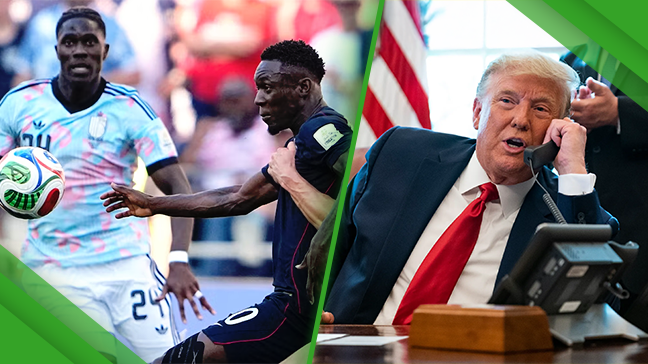
The United States’ World Cup campaign ended in controversy and disappointment after Belgium won 4-1, just days after President Donald Trump’s intervention helped make Folarin Balogun available for the Round of 16 match.
The United States have been eliminated from the 2026 FIFA World Cup after a 4-1 defeat to Belgium in the Round of 16, ending the co-hosts’ tournament in one of the most politically charged matches of the competition.
The match in Seattle was already a major sporting event. The USA had reached the knockout stage on home soil and had generated strong domestic momentum around the tournament. But the build-up was dominated by controversy after President Donald Trump intervened in the disciplinary case involving striker Folarin Balogun.
Balogun had received a red card in the previous knockout match against Bosnia and Herzegovina, which normally meant an automatic suspension for the next game. That would have ruled him out of the Round of 16 against Belgium. However, Trump later confirmed that he had spoken with FIFA President Gianni Infantino and asked FIFA to review the decision, calling the red-card punishment unfair.
FIFA then allowed Balogun to play against Belgium, triggering criticism from Belgium and from European political figures who questioned whether the decision had damaged the neutrality and integrity of football governance. FIFA maintained that the matter had been handled by an independent disciplinary process.
The decision created a powerful storyline before kick-off. For the United States, Balogun’s availability looked like a major sporting boost. For Belgium, it appeared to add extra motivation. The match quickly turned against the hosts.
Belgium started aggressively and took control early. Charles De Ketelaere scored twice in the first half, while Malik Tillman briefly gave the USA hope with a goal in the 31st minute. But Belgium remained the more clinical team. Hans Vanaken added a third goal after the break, and Romelu Lukaku completed the 4-1 scoreline in stoppage time.
The result ended the USA’s dream of reaching a first World Cup quarterfinal since 2002. It also ended the tournament for all three North American co-hosts, with Canada and Mexico already eliminated earlier in the knockout stage.
For the American team, the defeat was painful on several levels. The USA had shown progress during the tournament, winning important matches and building public attention around football in a country still trying to convert World Cup excitement into long-term soccer growth. But against Belgium, the gap in experience, finishing and tournament control was clear.
The political controversy made the exit even more dramatic. Instead of becoming the story of a home team making a deep run, the USA’s final match became linked to questions about political influence, disciplinary transparency and FIFA governance. Trump’s intervention may have helped make Balogun available, but it could not change the result on the pitch.
For Belgium, the victory was both sporting and symbolic. The team advanced to the quarterfinals with a convincing performance and showed that it could handle a hostile environment, a high-pressure knockout match and the noise surrounding the Balogun case. Belgium now moves forward as one of the most dangerous teams left in the tournament.
For the sports betting and data industry, the episode is especially significant. High-profile political involvement in a disciplinary decision can affect market expectations, player availability, media narratives and fan sentiment. When a player’s suspension is reversed shortly before a knockout match, odds, team projections and betting behaviour can shift quickly.
The case also highlights the importance of transparent governance in football. Betting markets depend heavily on trust in official information, clear disciplinary processes and reliable player-status updates. Any perception that decisions can be influenced by politics creates risks for market confidence, sports integrity and regulatory oversight.
The wider lesson is that modern World Cup matches are not only sporting events. They are also media, political, commercial and betting events. The USA-Belgium match brought all of those elements together: a host nation, a star striker, a presidential intervention, a FIFA controversy and a heavy defeat.
The conclusion is clear: the United States left the World Cup not only with a painful sporting loss, but with one of the tournament’s biggest governance controversies. Trump’s call helped bring Balogun back into the lineup, but Belgium’s 4-1 win showed that influence off the field cannot replace execution on it.
Share

-
 Mancala Gaming Launches Mariachi Millona...Mancala Gaming has released Mariachi Mil...October 27, 2026
 -
 Altenar to Showcase Its Flexible Sportsb...Leading sportsbook provider Altenar will...October 27, 2026
 -
 Secret of the Witch, where dark magic hi...ONLYPLAY invites players into the dark w...October 27, 2026


