


The Swahili Treasure: How the Complex Game of Bao Can Teach Gambling Products to Retain Players
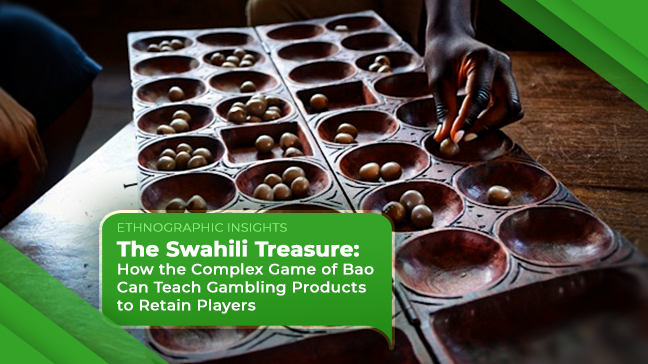
East Africa values skill over speed. Here, the national sport is Bao — one of the most complex and profound variations of mancala in the world. For gambling operators, this is both a challenge and an opportunity. We explore how the philosophy and mechanics of the "game of Swahili merchants" can form the basis for products with incredible depth and retention potential.
Object of Analysis – The Game of Bao Bao (which means "board" in Swahili) is the pinnacle of the evolution of the mancala family of games. It is the national game of Tanzania and is also extremely popular in Kenya, Zanzibar, Mozambique, and other countries in the Indian Ocean basin. Unlike the simpler Oware, Bao has more complex rules, several phases of play, and requires players to have the highest level of combinatorial thinking.
The Essence of the Game The game board consists of four rows of eight pits. The game has two stages:
- Namnamua: The initial phase, where players introduce seeds from their stock into the game, trying to "capture" the opponent's pits.
- Mtaji: The main phase, when all seeds are already on the board. Players make moves by "sowing" seeds from their pits.
Key distinctions of Bao include the presence of a special main pit called the "nyumba" (house), complex capture rules, and the ability to make very long, multi-move combinations ("takata"). The goal is to leave the opponent with no legal moves or to capture all the seeds in their front row.
History of the Game The history of Bao is inextricably linked with Swahili culture and maritime trade along the coast of East Africa. It is believed that the game was spread by Arab and Indian traders over a thousand years ago. Bao boards are true works of art, often passed down from generation to generation. Bao championships in Tanzania draw thousands of spectators.
Why It's Popular
- Prestige: Being a Bao master ("bingwa") is highly honorable. It is a sign of great intellect and strategic talent.
- Endless Depth: Even after thousands of games, it reveals new tactical possibilities.
- Cultural Status: It is not just entertainment but a part of cultural identity, like chess in Europe.
Player Psychology Bao is a game of pure mathematics and combinatorics. A player must be able to calculate 10-15 moves ahead, remember the number of seeds in dozens of pits, and constantly analyze the changing situation. It is a game for patient and very intelligent analysts capable of processing a vast amount of information.
Statistics on Game Knowledge Among East Africans Although its popularity may decline outside of coastal regions and islands (Zanzibar, Comoros), in Tanzania and coastal Kenya, awareness of Bao among the male population approaches 100%. It is an integral part of life, like football or card games.
Integrating Game Mechanics into Gambling Products
- A Complex Bonus Round: For "smart" players. In the bonus game, the player must solve a small tactical puzzle from Bao — make one move that yields the maximum number of "captured" seeds. The number of seeds is directly converted into the size of the win.
- "Takata" Crash Game: The player places a bet, and an animation of a long "takata" move begins. The multiplier increases with each pit the seeds pass through. The longer the move, the higher the risk of a "crash" (an unsuccessful end to the move).
Alternative Formats
- Bao-Themed Slot:
- Symbols: A Bao board, mkoma tree seeds, a dhow boat, a Zanzibari door, a chest of spices.
- "Nyumba" Mechanic: The central reel has a special "nyumba" cell. If a Wild symbol lands in it, it doesn't just substitute for other symbols but triggers a "sowing" of Wilds into adjacent cells, mimicking a move in Bao.
Creatives Using the Game's Sacred Symbolism in Advertising
- Visuals: Use images of the Zanzibar coast, ancient stone towns, and spice merchants. Emphasize skill over luck. Showcase a beautiful, expensive Bao board as a status symbol.
- Slogans: "The game for those who think," "Calculate your winnings," "Become a Bao master — become a master of the game."
- Narrative: An advertisement could show a competition between two respected Bao masters, where tension and intellect are more important than chance. This would create an image of a product for an intelligent and respectable audience.
Share

-
 Altenar Highlights Ice Hockey Early Payo...Altenar is highlighting its Early Payout...October 21, 2026
 -
 Slotegrator opens registration for free ...Slotegrator, a leading iGaming software ...October 21, 2026
 -
 QTech adds ELA Games to Global PlatformQTech, the leading game aggregator for e...October 21, 2026


