


The Efficiency Era: Why Strategy is Replacing Scale in iGaming
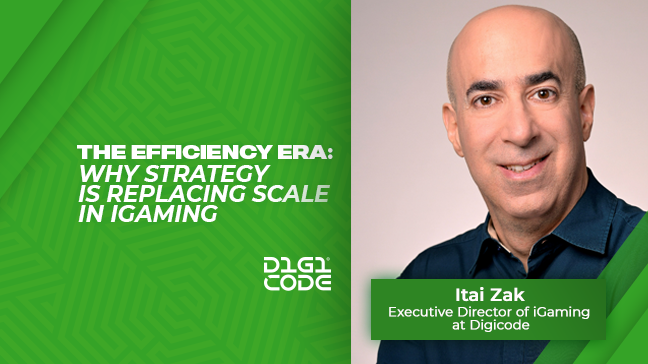
In iGaming, the idea of “efficiency” is often misunderstood. For some, it simply means cutting costs or slowing expansion. And as Itai Zak, Executive Director of iGaming at Digicode, explains, real efficiency is not about doing less, but designing smarter systems. When done well, it reshapes how games are built, discovered, and scaled across increasingly crowded platforms.
So what actually defines efficiency in today’s iGaming ecosystem? And why are some studios and operators adapting faster than others? A closer look at player behavior and platform dynamics reveals how the industry is quietly restructuring for the years ahead.
The Industry Is Entering an Efficiency Phase
For much of the past decade, growth in iGaming was driven by expansion. Operators entered new markets, studios released more titles, and platforms competed to offer the largest portfolios possible. Today, that model is under pressure.
Casino lobbies now contain thousands of games. Player acquisition costs have risen sharply, and audiences have become far more selective. If a product feels slow, confusing, or generic, players move on almost instantly. This is pushing the industry into an efficiency phase. Studios and operators are no longer focused purely on scale; instead, they are asking how games perform, how they are discovered, and how effectively they retain players once found.
From our experience working with operators and product teams at Digicode, the companies that succeed over the next few years will not necessarily be the largest. They will be the ones who understand player behavior and design products around the way platforms actually function.
Mobile-First: Still Misunderstood
Even after years of discussion around mobile-first design, many studios still build mobile games as if they were desktop titles compressed onto smaller screens. But mobile play is a different behavioral environment. Players often interact with one hand, during short sessions, and while multitasking. Their tolerance for complexity is low.
Overcomplicated layouts are a common issue. Too many animations, controls, or menus may feel impressive on a desktop but quickly overwhelm mobile users. Furthermore, mobile gameplay often lasts only a few minutes. Games that require long onboarding flows or slow loading sequences lose engagement quickly.
Studios that perform well on mobile focus on a few key principles: fast access, simple controls, short gameplay loops, and reliable performance. In many regions, network quality varies significantly, so optimization is vital. Mobile success rarely comes from adding features; it usually comes from removing friction.
Discovery Is the Real Challenge
Game discovery has become one of the most difficult problems in modern iGaming. With thousands of titles on most platforms, even strong games can disappear if they fail to gain early visibility. Players rarely search for specific titles; most discovery happens through lobby placement, featured sections, or operator promotions.
This makes the launch strategy critical. Games that appear prominently at launch attract more players and generate the engagement data operators use to determine whether to continue promoting the title. Early metrics such as session length, repeat play, and initial retention are closely monitored. If players leave quickly, visibility drops. If engagement is strong, the game receives more exposure. Discovery rarely happens by chance; it is the result of a coordinated effort between studios and operators.
Retention for Digital-Native Players
Another major shift comes from younger audiences. Digital-native players grew up with mobile games, social apps, and streaming platforms. Their expectations for interaction differ significantly from those of traditional casino audiences.
Retention for these players is less about bonuses and more about engagement. Short-term goals often work well—missions, challenges, or milestone achievements provide a sense of progress even when outcomes remain random. Competitive elements, such as leaderboards and time-limited tournaments, also give players a reason to return. Speed is equally important; fast rounds and smooth navigation significantly improve engagement for players who play in quick bursts.
What the Industry Misreads About Gen Z
One of the biggest misconceptions about Gen Z players is that they are simply younger versions of traditional gamblers. Their expectations are shaped by entirely different digital habits.
Many operators assume larger bonuses drive engagement, but in reality, younger audiences often value the overall experience more. Fast payments, clear interfaces, and reliable platforms matter far more than aggressive promotions. Transparency is another key factor; if rules or bonus conditions are confusing, players quickly lose trust.
Cultural Nuance and Local Adaptation
Localization in iGaming often focuses on language and payment methods, but deeper cultural patterns shape how games perform.
- Game Rhythm: Players in Nordic markets often prefer fast, clean gameplay, while in Southern Europe or parts of Latin America, richer visuals and longer animations tend to resonate more.
- Risk Preferences: Some regions favor high-volatility games with larger wins, while others respond better to frequent smaller payouts.
- Social Interaction: Some markets enjoy chat features and tournaments, while others prefer faster, individual gameplay.
These differences highlight a simple truth: games that scale globally still need to adapt locally.
Where the Industry Goes Next
The next phase of iGaming growth will not be driven by volume alone. Studios will need to design games around real player behavior, particularly mobile interaction patterns and short session dynamics. Operators will need to treat launch strategy as a core part of product success, not just marketing support.
In the efficiency era, success will come not from producing more content, but from creating experiences that work better for the players who actually engage with them.
Share

-
 South Africa’s Content Market Is Crowded...South Africa’s gambling market continues...October 22, 2026
 -
 SOFTSWISS Group CSO Wins Top Global CISO...SOFTSWISS Group Chief Security Officer E...October 22, 2026
 -
 BF Games Puts Juicy Booster in the Spotl...BF Games has showcased Juicy Booster thr...October 22, 2026


