


South African Casinos Face June 30 Deadline for AML Compliance Returns
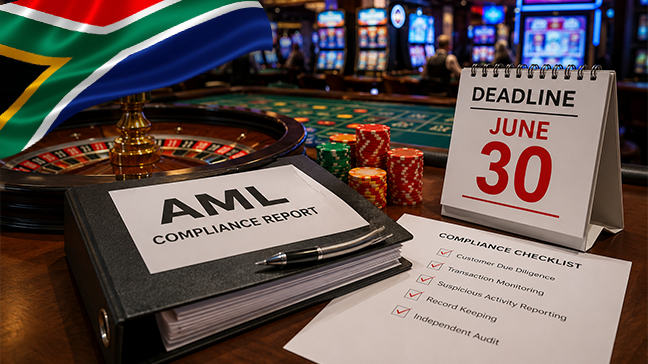
South African casinos must submit their 2026 Risk and Compliance Return to the Financial Intelligence Centre by June 30, as the regulator pushes accountable institutions to strengthen anti-money laundering and counter-terrorist financing controls.
South African casinos have until June 30, 2026 to submit anti-money laundering compliance information to the Financial Intelligence Centre as part of the regulator’s 2026 Risk and Compliance Return process.
The Risk and Compliance Return, or RCR, is an electronic self-assessment questionnaire that requires specified accountable institutions to provide information on their exposure to money laundering, terrorist financing and proliferation financing risks. It also asks institutions to show how they have implemented risk-based controls under the Financial Intelligence Centre Act.
The submission requirement is set out in Directive 11 of 2026. The RCR platform opened on May 4, 2026, with different deadlines depending on the category of accountable institution. Casinos fall under the June 30 deadline, together with trust and company service providers, certain credit providers, the Post Bank, the South African Mint and crypto asset service providers.
The deadline is important because casinos are considered higher-risk businesses from an AML perspective. Gaming venues handle large volumes of cash, customer transactions, payouts and high-value activity, which can create vulnerabilities if operators do not maintain strong customer due diligence, transaction monitoring and reporting systems.
The FIC has warned that submission levels remain low among sectors facing the June deadline. As of June 17, only 655 of 5,614 registered entities in the relevant categories had submitted their 2026 RCRs, representing 11.66% of registered entities. This suggests that a large number of businesses still need to complete the process before the deadline.
For casinos, the RCR is more than a routine filing exercise. It gives the regulator insight into how operators understand their risk exposure, how they classify customers, how they monitor transactions, how they detect suspicious activity and how they apply internal controls. The information can also help the FIC identify weaknesses across the sector and focus future supervision on higher-risk areas.
The process comes at a time when South Africa continues to strengthen its financial crime framework. The country has been under pressure to improve AML and counter-terrorist financing controls, and regulators are increasingly using risk-based supervision to assess whether businesses are applying the law in practice, not only on paper.
For the gambling industry, the message is clear: compliance expectations are rising. Casinos must be able to show that they understand their exposure to financial crime and that they have systems in place to manage those risks. This includes staff training, record-keeping, suspicious transaction reporting, customer screening and monitoring of unusual betting or payout patterns.
The deadline also matters for licensed operators from a reputational perspective. A casino that fails to submit the RCR on time may attract regulatory attention and could be seen as having weak compliance discipline. In a sector where trust, licensing and oversight are central to business continuity, late or incomplete submissions can create unnecessary risk.
For suppliers and business partners, the RCR process may also become relevant. As regulators pay closer attention to financial crime exposure, casinos may need to review relationships with payment providers, junket-style intermediaries, high-value customers and other partners that could affect their AML risk profile.
The South African case reflects a broader trend in global gambling regulation. Authorities are no longer focusing only on licensing and tax collection. They are also demanding stronger proof that operators can prevent their platforms and venues from being used for money laundering, terrorist financing or other illicit financial activity.
The conclusion is clear: the June 30 deadline is a significant compliance moment for South African casinos. Operators that submit accurate and complete RCR information will be better positioned to show the FIC that they understand their risk obligations, while those that delay may face closer regulatory scrutiny.
Share

-
 Amigo Gaming Launches Black Flag Fortune...Amigo Gaming has released Black Flag For...October 16, 2026
 -
 Amusnet Expands South African Footprint ...Amusnet, a leading global provider of pr...October 16, 2026
 -
 BetOnGames takes the stage with Joker Mi...BetOnGames, part of BETCORE, has release...October 16, 2026


