


Kenya Moves to Geo-Blocking Rules for Foreign Betting Operators
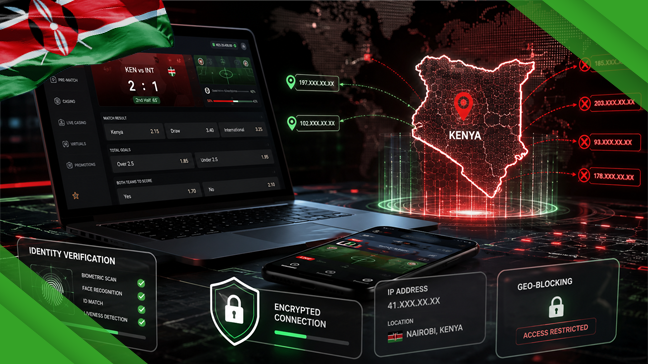
Kenya has introduced strict geo-blocking and identity-verification duties for foreign-based gambling operators, creating a new compliance test for firms using Kenyan licences while serving markets outside the country.
Kenya is moving to require foreign-based gambling operators to block Kenyan residents from accessing their platforms, marking a major shift in how the country supervises offshore-linked betting businesses.
The new framework is set out in the Gambling Control (Foreign-Based Operators) Regulations, 2026, listed as Legal Notice No. 113 of 2026. The rules are issued under the Gambling Control Act, 2025 and form part of Kenya’s broader transition to a more centralised gambling regime under the Gambling Regulatory Authority.
At the centre of the regulations is a clear technical requirement: foreign-based operators must implement measures including IP geo-blocking and identity verification to ensure that persons resident in Kenya cannot access their gambling platforms.
The rule targets operators that may hold a Kenyan licence but generate their gambling revenue from markets outside Kenya. In practice, Kenya is trying to prevent such operators from using a local licence while still accepting bets from Kenyan customers outside the normal domestic regulatory and tax framework.
The compliance burden is significant. Reports indicate that operators that fail to stop Kenyan residents from accessing their platforms may face administrative fines of up to KES 50 million. The GRA may also suspend or revoke licences and order the forfeiture of security bonds where serious breaches occur.
The regulations also give the Authority stronger monitoring tools. Foreign-based operators may be required to provide remote, real-time access to central servers and gaming systems so that regulators can monitor financial flows and confirm that bets are not being processed from within Kenya.
Quarterly technical audits are another important feature. These audits are intended to test whether geo-fencing measures actually work, rather than relying only on written assurances from operators. This makes Kenya’s approach more technical and evidence-based than a simple licensing declaration.
The framework also includes financial-entry requirements. Foreign-based operators are expected to demonstrate substantial paid-up capital and provide a security bond or bank guarantee. This signals that Kenya wants only financially credible firms operating under this category.
Another key element is host-jurisdiction compliance. Operators must show that their gambling activities are lawful and properly licensed in the foreign markets where they operate. A breach of laws in a host jurisdiction may become a material violation that can trigger action in Kenya.
This is important because Kenya is not simply exporting licences. It is creating a controlled offshore-operator category that depends on both Kenyan supervision and compliance with foreign regulatory environments. Operators cannot use Kenya as a regulatory base while ignoring the laws of the markets they actually serve.
The geo-blocking requirement also has a consumer-protection function. By preventing Kenyan residents from accessing foreign-based platforms, the GRA can steer local players toward operators licensed and supervised for the domestic Kenyan market, where tax, responsible gambling and consumer-protection rules apply more directly.
For Kenya’s regulated betting market, the measure may reduce tax leakage. If Kenyan residents bet through foreign-facing platforms, the state risks losing revenue from betting taxes, withholding tax on winnings, licence fees and other domestic obligations. Geo-blocking is therefore both a compliance tool and a fiscal-control mechanism.
For operators, the message is clear: holding a licence is not enough. Companies must now prove that their digital perimeter works, their customer verification systems are reliable and their revenue is genuinely generated outside Kenya where that is the basis of their licence category.
The rules may also affect technology suppliers, payment processors and compliance vendors. Operators will need more sophisticated systems for IP screening, identity checks, location monitoring, transaction reporting, AML controls and regulator access.
However, enforcement will be challenging. Geo-blocking can be undermined by VPNs, proxy services, third-party accounts and cross-border payment methods. To be effective, Kenya’s regime will need continuous testing, strong data access and cooperation with payment providers and foreign regulators.
The broader significance is that Kenya is positioning itself as a stricter gambling jurisdiction. The 2026 regulations do not only cover licensing; they also create operational standards, advertising rules, appeal mechanisms and specific obligations for foreign-based operators.
For the industry, this marks a move from paper compliance to technical compliance. Operators will be judged not only on whether they submit the right documents, but on whether their systems can actively prevent unauthorised access and demonstrate it to the regulator.
Kenya’s geo-blocking rules could become a reference point for other African markets dealing with offshore betting leakage. As online gambling becomes more cross-border, regulators are increasingly looking for tools that combine licensing, tax protection, player protection and digital enforcement.
The next test will be implementation. If the GRA applies audits consistently and acts against operators that fail to block Kenyan residents, the rules could strengthen the credibility of Kenya’s gambling regime. If enforcement is weak, the framework may become another formal requirement that offshore operators learn to work around.
For now, the direction is clear: Kenya wants foreign-based betting operators to prove that they are truly foreign-facing. Access by Kenyan residents is no longer a grey area. It is becoming a direct compliance risk.
Share

-
 South Africa’s Content Market Is Crowded...South Africa’s gambling market continues...October 22, 2026
 -
 SOFTSWISS Group CSO Wins Top Global CISO...SOFTSWISS Group Chief Security Officer E...October 22, 2026
 -
 BF Games Puts Juicy Booster in the Spotl...BF Games has showcased Juicy Booster thr...October 22, 2026


