


Indonesia suspends welfare aid for 1.49 million households over online gambling concerns
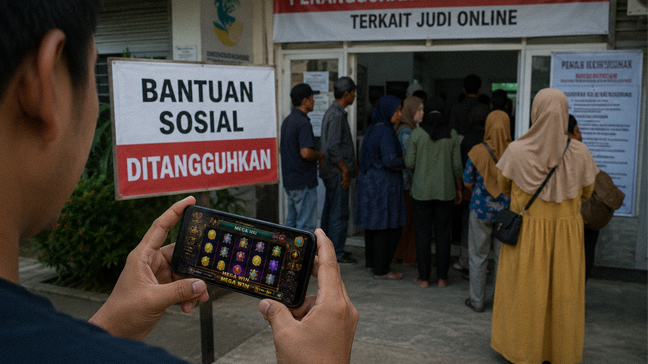
Indonesia’s Ministry of Social Affairs has temporarily suspended food-assistance payments to nearly 1.5 million beneficiary households after financial intelligence data linked their accounts to suspected online gambling transactions, while authorities carry out a nationwide verification process.
Indonesia has temporarily suspended social assistance for 1,494,652 beneficiary households after data matching identified possible links between their accounts and online gambling transactions. The affected families are enrolled in the government’s Basic Food Assistance Program, while the Ministry of Social Affairs investigates whether the transactions represent deliberate misuse of welfare support.
The cases were identified through information supplied by the Financial Transaction Reports and Analysis Center (PPATK), Indonesia’s financial intelligence agency. Social Affairs Minister Saifullah Yusuf confirmed on August 6 that the flagged households are now undergoing further investigation and verification. Of the 1.49 million families concerned, 794,475 are also registered as beneficiaries of the Family Hope Program, or PKH.
The suspension is precautionary rather than a final decision to permanently remove every household from the welfare system. Yusuf said authorities will examine whether gambling activity was intentional, whether violations were repeated and whether the households continue to meet the eligibility requirements for state support. If deliberate and repeated misuse is confirmed, benefits may be permanently withdrawn and redirected to other eligible families.
The scale of the latest review represents a sharp increase compared with earlier data matching. Authorities had previously identified close to 600,000 welfare-beneficiary households with suspected gambling-related activity. The latest figure is therefore more than twice as high, highlighting the continuing penetration of illegal online gambling among economically vulnerable sections of the population.
The Ministry of Social Affairs is working with PPATK and the Ministry of Communication and Digital Affairs to verify the findings. The process is also being used to update Indonesia’s National Socio-Economic Single Data system, known as DTSEN, which the government relies on to determine whether households remain entitled to social assistance. Officials have also warned beneficiaries against allowing other people to use their bank accounts or identities, since such activity could result in a household being incorrectly or legitimately flagged during financial monitoring.
Indonesia has increasingly connected its anti-gambling strategy with financial monitoring rather than relying only on website blocking. In July, the Ministry of Communication and Digital Affairs said authorities were expanding enforcement to target payment flows, bank accounts and the wider financial infrastructure supporting illegal gambling. Between October 20, 2024 and July 12, 2026, the ministry said it had acted against approximately 3.7 million gambling-related websites and pieces of online content, while around 32,500 suspected gambling-linked bank accounts had been closed following checks conducted with financial regulators.
The welfare decision also reflects the significant social impact attributed to online gambling in Indonesia. A PPATK strategic study published in May reported 12.3 million active online gambling players in 2025 and cited an estimated Rp1.163 quadrillion in illegal gambling-related fund circulation. The agency has linked online gambling to household debt, family problems, addiction and other social consequences observed across several regions of the country.
However, the government’s verification process will be crucial because the presence of a gambling-related transaction does not automatically prove that welfare money itself was intentionally used for betting. Authorities must distinguish deliberate misuse from cases involving shared, compromised or improperly used accounts before permanently removing families from assistance programmes. The temporary suspension therefore represents both an anti-gambling measure and a test of Indonesia’s ability to combine financial intelligence with accurate social-welfare targeting.
Share

-
 AssuredBets Named Signature Sponsor at i...AffPapa is pleased to announce that Assu...September 25, 2026
 -
 SOFTSWISS Sportsbook Supports Player Con...SOFTSWISS Sportsbook has released a rede...September 25, 2026
 -
 1spin4win unveils Egypt-inspired Lucky F...1spin4win, an established classic online...September 25, 2026


