


Ghana Begins Compliance Inspections as NLA Enforces Lotto Agent Registration
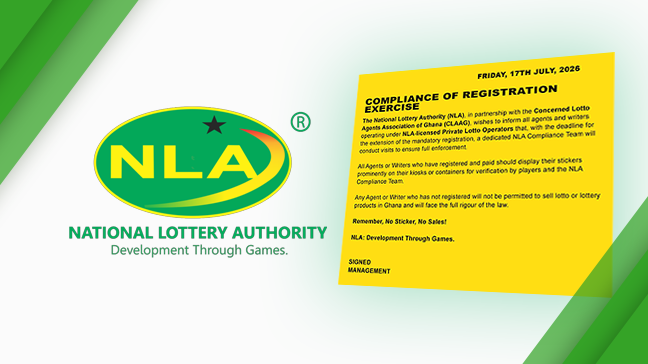
Ghana’s National Lottery Authority has moved into the enforcement phase of its “No Sticker, No Sales” campaign, launching nationwide inspections after the deadline for lotto agents and writers to complete mandatory registration.
Ghana’s National Lottery Authority has begun nationwide compliance inspections as it moves to enforce mandatory registration for lotto agents and writers operating under NLA-licensed private lotto operators.
The inspections mark the enforcement phase of the regulator’s “No Sticker, No Sales” campaign, a policy designed to ensure that only registered and identifiable sellers are allowed to distribute lotto and lottery products in Ghana.
The registration exercise was launched by the NLA in partnership with the Concerned Lotto Agents Association of Ghana. It required agents and writers to complete registration, pay the required fee and obtain an official compliance sticker. The sticker must be displayed prominently at kiosks, containers or sales points so that customers and compliance officers can easily verify whether a seller is authorised.
The NLA initially set a May 31 deadline for the registration exercise, before the process was later extended to June 30 to give affected agents and writers more time to comply. With the deadline now expired, the Authority has shifted from registration support to field enforcement.
Under the “No Sticker, No Sales” directive, unregistered lotto agents and writers are not permitted to sell lotto or lottery products in Ghana. Those found operating without the required approval may face enforcement action as the NLA’s compliance teams conduct inspections nationwide.
The campaign is intended to address one of the long-running challenges in Ghana’s lottery sector: the difficulty of distinguishing authorised agents from unlicensed or informal sellers. By requiring visible stickers at points of sale, the NLA aims to make compliance easier to verify both for regulators and for players.
For licensed private lotto operators, the inspections also increase responsibility across the distribution network. Operators can no longer treat agents and writers as peripheral sales actors. Their networks must now be documented, traceable and aligned with the regulator’s registration requirements.
The measure also has consumer-protection implications. When players buy lottery products from registered sellers, they are more likely to interact with channels that can be monitored, audited and connected to authorised operators. This reduces the risk of disputes, fake sales points and unauthorised use of lottery products or numbers.
The inspections form part of a wider effort to modernise Ghana’s lottery sector. Earlier this year, NLA leadership also indicated plans to transition lottery sales toward fully digital systems by the third quarter of 2026. That reform is expected to improve transparency, strengthen transaction monitoring and reduce reliance on hybrid paper-based models.
Together, agent registration and digitalisation point to a broader regulatory strategy: Ghana is trying to formalise the entire lottery chain, from operators and sales agents to writers, transactions and customer-facing points of sale.
For the market, the immediate impact will be practical. Agents and writers that completed the process and display the official sticker can continue operating. Those that failed to register may be removed from the legal sales network unless they regularise their status through the required channels.
For regulators, the next challenge will be consistency. A sticker system only works if inspections are sustained, records are accurate and enforcement is applied evenly across regions and operators. If monitoring weakens after the first phase, unregistered sellers may return to the market.
For compliant operators and agents, however, the inspections could help create a more orderly and trusted lottery environment. By reducing informal competition and making authorised sellers visible, the NLA may strengthen both revenue collection and public confidence in the sector.
Ghana’s move shows how African lottery regulation is becoming more operational and data-driven. Licensing alone is no longer enough. Regulators increasingly want proof that every layer of the distribution network is registered, visible and accountable.
The message from the NLA is clear: Ghana’s lottery market is entering a stricter compliance phase. For agents and writers, the official sticker is no longer just an administrative requirement. It is now the visible condition for staying in business.
Share

-
 Altenar Highlights Ice Hockey Early Payo...Altenar is highlighting its Early Payout...October 21, 2026
 -
 Slotegrator opens registration for free ...Slotegrator, a leading iGaming software ...October 21, 2026
 -
 QTech adds ELA Games to Global PlatformQTech, the leading game aggregator for e...October 21, 2026


