


Can Gambling Innovation Outrun Regulation? Martin Lyčka on AI, Prediction Markets and the Future of Industry Oversight
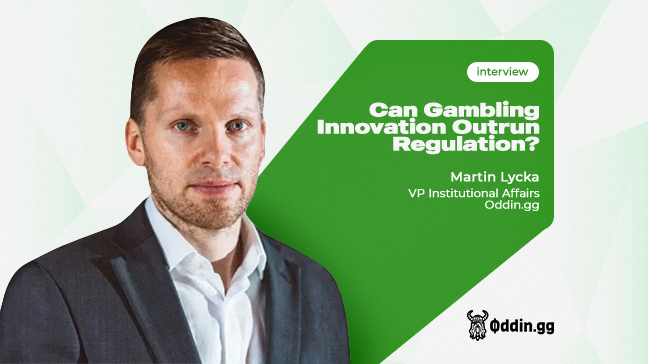
As artificial intelligence, prediction markets and new betting formats develop at unprecedented speed, regulators are facing an increasingly difficult task: protecting consumers without preventing legitimate innovation. In an interview with Gambling Talk, Martin Lyčka, Vice President of Institutional Affairs at Oddin.gg, discusses the widening gap between technology and regulation, the opportunities created by AI, the regulatory debate surrounding prediction markets, esports betting, black-market risks and why the industry needs smarter - rather than simply stricter - regulation.
Technological change has rarely waited for legislation.
For the gambling industry, that challenge has become particularly visible as artificial intelligence, prediction markets, esports betting and increasingly sophisticated data-driven products develop faster than traditional regulatory frameworks can adapt.
Speaking with Gambling Talk, Martin Lyčka, Vice President of Institutional Affairs at Oddin.gg, argued that the gap between technological innovation and regulation is becoming increasingly difficult to ignore.
However, he does not see the answer in forcing regulators to chase every technological development individually. Instead, he believes the industry and public authorities need much closer communication, education and cooperation.
Regulation Is Struggling to Match the Pace of Innovation
Regulators and legislators face an inherent structural disadvantage when dealing with rapidly developing technology.
Creating or changing legislation can require consultations, political debate, technical assessments and lengthy approval processes. Technology companies, meanwhile, can develop and launch new products within months or sometimes weeks.
Lyčka believes this makes a certain gap between innovation and regulation almost unavoidable.
The industry's responsibility, however, should not simply be to complain that regulators are too slow.
Instead, operators, suppliers and technology companies need to help policymakers understand how new products actually work, what risks they create and what safeguards can realistically be introduced.
For Lyčka, the most effective model is one in which regulators and the industry move as closely as possible “in lockstep”, rather than treating one another as opposing sides.
That principle becomes particularly important when dealing with technologies such as artificial intelligence.
AI Could Transform Almost Every Part of Gambling
Artificial intelligence is often discussed primarily in the context of personalization and marketing, but Lyčka sees its potential extending much further across the gambling ecosystem.
AI can already support areas including responsible gambling, fraud detection, anti-money laundering processes, integrity monitoring and risk assessment.
It may also help detect suspicious activity linked to black-market operators and identify patterns potentially associated with game or betting manipulation.
Oddin.gg itself has been incorporating AI-powered capabilities into its technology and products, including solutions presented at major industry events such as ICE Barcelona.
From Lyčka's perspective, the real significance of AI is its ability to operate across almost every layer of the industry.
The same technology that can help companies understand customers commercially can potentially be redeployed to detect vulnerability, suspicious financial behaviour or integrity risks.
AI is therefore unlikely to remain a specialist technology sitting within isolated departments. It is becoming part of the industry's wider operating infrastructure. And its impact may extend beyond gambling.
Lyčka noted that AI is increasingly being used in areas ranging from marketing to legal work - joking that professionals may eventually need to start questioning their own job security.
But greater adoption also inevitably raises new questions about oversight, transparency and responsibility.
Prediction Markets Are Testing Traditional Regulatory Definitions
Few areas illustrate the tension between innovation and regulation more clearly than prediction markets.
Different jurisdictions are already reaching very different conclusions about how these products should be classified.
In the United States, certain prediction-market products have developed within the framework of event contracts and fall under the oversight of the Commodity Futures Trading Commission (CFTC).
Elsewhere, including parts of Europe, Canada and Brazil, similar products may be treated as gambling, betting exchanges or prohibited products depending on the local legal framework.
For Lyčka, this demonstrates why prediction markets cannot be considered exclusively from a technological perspective.
Classification matters. A product considered a financial instrument in one jurisdiction could be considered gambling in another. Yet he also sees prediction markets as part of an evolutionary process rather than something entirely disconnected from established betting products. Many of their characteristics have parallels with betting exchanges and other forms of wagering that the industry and regulators have dealt with before.
The central regulatory question is therefore not simply whether prediction markets are “new”, but which legal framework should apply to them.
What Happens When a Product Does Not Fit Existing Rules?
That question becomes more complicated when genuinely new products sit somewhere between traditional categories.
A platform may contain characteristics of sports betting, financial speculation and exchange-based trading without fitting perfectly into any single definition.
Lyčka advocates a pragmatic response. Companies should engage regulators early, explain exactly how their products operate and determine whether those products can function under existing rules.
If they cannot, several possible outcomes exist. The regulatory framework may need to change. Legislation may require amendment. Alternatively, the product itself might have to be redesigned to comply with existing requirements.
For Lyčka, direct communication remains the most efficient route. The practical answer is likely to differ from jurisdiction to jurisdiction, particularly as gambling regulation remains highly fragmented internationally.
Consumer Protection Must Remain Non-Negotiable
Innovation, however, cannot come at the expense of player protection. Lyčka described customer protection as an absolute imperative.
There is also, he argued, a clear commercial rationale behind that position. A sustainable gambling business does not benefit from customers experiencing severe harm or rapidly exhausting the money they can afford to spend. At the same time, he cautioned against assuming that ever-stricter regulation automatically produces better outcomes.
Regulated operators need viable businesses capable of generating the revenue required to invest in technology, compliance, responsible-gambling tools and customer protection.
If taxation and regulation make licensed products significantly less attractive than their unlicensed alternatives, policymakers may create unintended consequences.
One of the greatest risks is channelisation.
Players facing excessive restrictions, unattractive products or substantial differences between regulated and offshore offerings may migrate towards black-market operators where consumer protections are significantly weaker.
Lyčka is particularly concerned about governments using gambling taxation as a short-term response to wider economic pressure.
High tax rates combined with restrictive regulation can undermine the competitiveness of the licensed market and potentially drive consumers towards illegal alternatives.
The challenge is therefore not simply creating “more regulation”. It is creating smart regulation.
Esports Betting Is Becoming Increasingly Normalised
Esports represents another area where regulatory attitudes are gradually changing.
Concerns surrounding competition integrity, participant age, match manipulation and betting integrity have historically made some regulators cautious about permitting esports wagering.
Lyčka argues, however, that modern esports betting operates within increasingly sophisticated compliance and integrity structures.
Many of the standards applied to traditional sports betting - including monitoring suspicious activity and protecting competition integrity - can also be applied effectively to esports.
Regulatory education remains necessary, but the direction of travel is changing.
An increasing number of US states now permit various forms of esports betting, while restrictions in other international markets are gradually being reconsidered.
Some major European jurisdictions, including France and Germany, remain comparatively restrictive.
Lyčka believes that the growing body of evidence from markets where esports betting has been successfully regulated will ultimately influence jurisdictions that remain cautious.
In other words, successful regulation elsewhere may become one of the industry's strongest arguments.
Player Data Is Becoming a Protection Tool
The gambling industry's use of player data creates another complicated regulatory issue.
Historically, large volumes of behavioural information were collected primarily for commercial purposes - improving marketing, segmentation and personalization.
That same information is increasingly being used for very different objectives.
Operators can analyse behavioural patterns to identify customers potentially showing signs of vulnerability and intervene earlier.
For Lyčka, existing data-protection frameworks - particularly those developed in the European Union - already provide important safeguards.
Other jurisdictions are increasingly adopting similar principles.
The more significant development may therefore be how operators use information they already possess. Data originally collected to understand customers commercially can increasingly become part of responsible-gambling and player-protection systems.
The Next Regulatory Battle
Asked which development could pose the greatest regulatory challenge over the coming five years, Lyčka pointed to several interconnected areas rather than one isolated technology.
The relationship between prediction markets and the traditional betting industry is likely to demand particularly significant regulatory attention in the near term.
Many of those questions may begin to be resolved within the next few years.
AI and esports, meanwhile, are becoming so deeply embedded across the gambling ecosystem that they are unlikely to remain separate regulatory topics.
They will increasingly form part of the broader infrastructure of betting, gaming, integrity, compliance and customer protection.
The challenge for policymakers will be avoiding short-term regulatory responses to long-term technological change.
For Lyčka, the objective should be clear: regulation should protect consumers while still allowing legitimate businesses and technological innovation to develop.
The future of gambling oversight may therefore depend less on whether regulators can move as quickly as technology an almost impossible task and more on whether regulators and the industry can develop mechanisms capable of adapting intelligently as technology changes.
That means closer cooperation, continuous education and, above all, smarter regulation. Because innovation is unlikely to slow down simply because legislation needs more time.
Share

-
 EGT to showcase new slot and ETG solutio...EGT is ready for another memorable G2E L...September 23, 2026
 -
 Logifuture presents more premium content...QTech, the leading game aggregator for e...September 23, 2026
 -
 “Key Product Trends in the US”: Intervie...The US sportsbook market has evolved wel...September 23, 2026


