


Argentina Set Up Historic World Cup Final Against Spain After Dramatic Win Over England
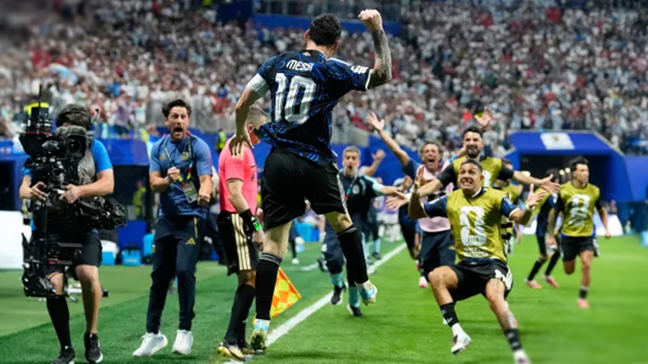
Argentina came from behind to beat England 2-1 and reach the 2026 FIFA World Cup final, where the defending champions will face Spain in a rare showdown between the top two teams in the FIFA ranking.
Argentina have reached the 2026 FIFA World Cup final after a dramatic 2-1 comeback victory over England in Atlanta, setting up one of the most prestigious finals in modern football history against Spain.
England looked close to reaching their first men’s World Cup final since 1966 after Anthony Gordon opened the scoring in the second half. Thomas Tuchel’s team then dropped deeper, trying to protect the lead, but Argentina increased the pressure and turned the match around in the closing minutes.
Enzo Fernández equalised in the 85th minute, before substitute Lautaro Martínez scored the winner in stoppage time after a decisive delivery from Lionel Messi. The result sent Argentina into a second consecutive World Cup final and kept alive their bid to become the first team since Brazil in 1962 to defend the title.
For England, the defeat was another painful chapter in a long history of near misses. The team had been minutes away from a final, but the late collapse revived familiar questions about game management, substitutions and the ability to control decisive knockout matches under pressure.
For Argentina, the victory again showed the team’s defining tournament quality: survival. Lionel Scaloni’s side have repeatedly found ways through difficult matches in this World Cup, including tense knockout wins over Cape Verde, Egypt, Switzerland and now England. Their route has not always been comfortable, but it has reinforced the image of a team built on experience, resilience and emotional control.
The match also produced controversy. British media reaction was intense, with The Telegraph publishing an article describing “31 dirty tricks” allegedly used by Argentina to unsettle England. The piece framed Argentina’s performance through the lens of “dark arts” — tactical fouls, provocation, delays and psychological pressure.
Such claims should be treated as media interpretation rather than official disciplinary findings. However, they reflect a wider debate around Argentina’s style in knockout football. Supporters see it as competitive intelligence and elite mentality; critics view it as gamesmanship that pushes the limits of sportsmanship.
The tension was increased by Argentina’s post-match celebrations, after some players displayed a banner referencing the Malvinas/Falklands dispute. That incident may now draw additional attention from FIFA, especially because political messaging at matches is usually subject to strict rules.
The final against Spain will now carry several layers of meaning. It will be a meeting between the reigning world champions and the reigning European champions. It will also bring together Argentina, ranked No. 1 before the tournament, and Spain, ranked No. 2 — making the final a rare elite-level collision between the two highest-ranked teams in world football.
Spain enter the final after beating France 2-0 and matching the world record for the longest unbeaten run in international football. La Roja have been one of the most controlled and defensively reliable teams of the tournament, while Argentina have built their campaign on drama, late goals and Messi’s leadership.
The contrast is clear. Spain represent structure, possession and collective balance. Argentina represent survival, pressure, emotion and decisive individual moments. For broadcasters, sponsors and fans, the matchup is close to ideal: Messi against Lamine Yamal, South America against Europe, defending champions against the most consistent team of the tournament.
The 2026 World Cup final will therefore be more than a title match. It will decide whether Argentina can complete a historic title defence, or whether Spain can turn its unbeaten run into a second world crown. After two dramatic semi-finals, the tournament has produced a final worthy of its expanded stage — and one that may define the next era of international football.
Share

-
 Amigo Gaming Launches Black Flag Fortune...Amigo Gaming has released Black Flag For...October 16, 2026
 -
 Amusnet Expands South African Footprint ...Amusnet, a leading global provider of pr...October 16, 2026
 -
 BetOnGames takes the stage with Joker Mi...BetOnGames, part of BETCORE, has release...October 16, 2026


