


Why Brazil's RNG Casino Crackdown Could Push Operators Toward Poker Verticals
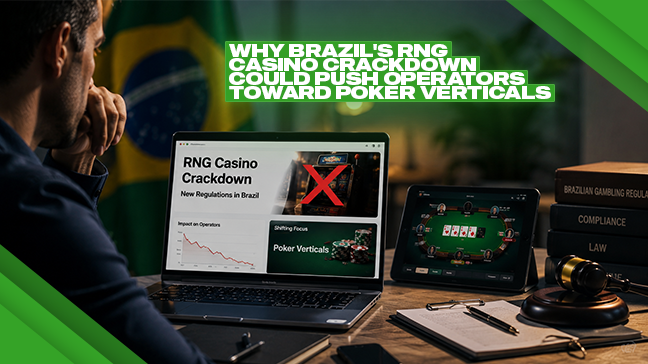
Brasília doesn't move fast on gambling policy. It moved fast on this one. Lula and the PT government threw their weight behind a bill in late July 2026 that would prohibit online casino games whose outcomes are generated by algorithms or electronic random number systems. Slots, crash games, RNG roulette, the whole category of chance-driven virtual titles that dominate most operators' Brazilian revenue lines, all sitting in the blast radius of a single piece of legislation.
That's a genuine problem for anyone with a licensed footprint in the country. But it's not a problem for everything.
Poker doesn't run on an RNG in the way a slot does. The outcome of a hand isn't manufactured by an algorithm deciding who wins, it's decided by cards dealt under fixed probabilities and then shaped entirely by human decisions afterward. That distinction, skill versus chance, is exactly the fault line Brazilian regulators appear to be drawing, and it's why poker verticals are suddenly looking like the more durable product line for operators trying to keep a foothold in the market. Operators looking to understand the strategic side of that distinction have a useful primer in Pokerology, which breaks down why poker's skill element keeps it in a different regulatory bucket entirely.
This isn't a theoretical distinction dreamed up by affiliates trying to protect a niche. Courts have wrestled with it for over a decade. When the case testing poker's classification as a skill game reached the US judicial system, the Supreme Court declined to even rule on it, leaving lower court findings that favored skill classification intact by default. Brazil's own legal framework leans the same direction. Under the current SPA/MF rules, skill-based games including poker are excluded from the definition of virtual events under fixed-odds betting regulation, which is precisely the carve-out operators need if the RNG ban clears congress.
The bill itself is narrower than the headlines suggest
Read past the initial coverage and the target is specific. Lawmakers are going after games where the house edge is baked into an algorithm nobody can inspect. Crash games. Aviator-style multiplier products. Slot mechanics dressed up with new themes every quarter. The bill's language, as reported by SBC News on July 30, targets outcomes generated by electronic or algorithmic systems, not gambling broadly.
That's a meaningfully different scope than a blanket casino ban. It also lines up with a pattern regulators across multiple jurisdictions keep returning to: treat the black-box RNG products as consumer-risk categories requiring tighter control, and treat skill games as something closer to sport.
A 2024 legal review out of Washington University put it plainly, arguing poker is predominantly a skill-based activity when analyzed under standard legal tests rather than one governed primarily by chance. Whether or not Brazil's final bill text explicitly cites that framework, the direction of travel matches it.
Why this actually matters for operators right now
Here's the thing. Brazil isn't a side market anymore. Betting operators poured resources into the country over the past two years, and the regulatory fights happening now are the ones that decide who keeps a functioning P&L there in 2027. A May 2026 hearing exposed just how high the stakes are: regulators cited over 31 million CPF numbers registered on legal betting platforms and bettor losses reaching R$36.8 billion in 2025 alone. That kind of scale draws exactly the scrutiny you'd expect.
Operators who diversified early into skill-game verticals aren't scrambling now. Poker rooms, poker-adjacent loyalty products, and strategy education content sit comfortably outside the algorithm argument because there's no algorithm deciding the winner. The house doesn't program the outcome of a hand the way it programs a slot's RTP curve.
This isn't limited to Brazil either. Watch how African regulators have been coordinating. Directors general and senior regulatory leaders from Nigeria, South Africa, Uganda, Ghana, and several other markets convened in London in early July 2026 specifically to align on gaming oversight across the continent. When regulators start comparing notes across borders, the RNG-versus-skill distinction tends to travel with them. Angola's newly opened provisional licensing window this July is one example of a market building its framework almost from scratch, and the operators moving into that window now have a real opportunity to bake skill-based products into their initial offering rather than bolting them on after a crackdown forces the issue.
What a poker pivot actually looks like in practice
It's not just adding a poker room and calling it diversification. The operators doing this well are building education layers around the product, strategy content, hand-history breakdowns, bankroll management guides, because poker's regulatory safety comes precisely from its skill framing. A poker room with zero educational infrastructure looks, to a skeptical regulator, uncomfortably close to a chance product with a card theme slapped on it.
That's a real risk. Treat poker as just another game in the lobby and you lose the argument that got you the exclusion in the first place.
The smarter operators are pairing poker verticals with visible skill-development content, partly for player retention, but mostly because it reinforces the legal distinction that makes the vertical worth building. Timing helps too. The 2026 WSOP Main Event just wrapped its final table in July, with ESPN's multi-year rights deal delivering six hours of daily live coverage. Mainstream poker attention is genuinely up right now, and that's a tailwind operators would be foolish to ignore while they're restructuring product lines anyway.
Compare that to the slot side of the business. Pragmatic Play's recent Cosmic Clusters release, built on a tumbling cluster-pays engine with a 5,000x max win, is a perfectly good product. It's also exactly the kind of algorithm-driven mechanic that sits in the crosshairs of Brazil's bill. Nobody's saying drop slots entirely. But a portfolio that's 90% RNG chance products and 10% skill products is a portfolio with a single point of regulatory failure.
The compliance argument, not just the growth argument
There's a version of this piece that frames poker as a growth opportunity. It is one. But the more urgent case is defensive. If the Brazilian bill passes in anything close to its current form, operators without a skill-game vertical lose access to a meaningful chunk of their product catalogue overnight, with limited time to build a replacement. Firms that have been quietly building poker infrastructure, tournament software, table game licensing, strategy content partnerships, aren't scrambling for a Plan B. They already have one running.
Legal counsel working in this space consistently point to the same distinguishing test: does the outcome depend on a player's decisions after the deal, or does an algorithm determine the result independent of anything the player does? A skill-gaming legal guide from Walters Law Group walks through exactly how courts apply that test across jurisdictions, and it's the same logic Brazilian lawmakers appear to be leaning on now.
None of this guarantees poker escapes every future regulatory pass. Regulation drifts, and a lawmaker in 2028 could decide skill-based games need their own scrutiny too. But right now, in August 2026, with a live bill in front of Brazil's congress and African regulators actively coordinating cross-border standards, poker is the safer bet in the literal sense of the word.
Frequently Asked Questions
Does Brazil's proposed bill ban online poker entirely? No. The bill as reported targets games whose outcomes are generated by algorithms or electronic RNG systems. Poker's outcomes depend on card probabilities plus player decisions, which is the distinction lawmakers and legal analysts point to when separating it from slots and crash games.
Why do regulators treat poker differently from slots? Courts and legislators generally apply a skill-versus-chance test. Slots have a fixed algorithm determining payout independent of player input. Poker outcomes shift based on betting decisions, bluffing, and strategy, which multiple legal reviews cite as grounds for separate treatment.
Could other countries follow Brazil's approach? It's plausible. African regulators met in London in July 2026 specifically to align oversight standards across markets including Nigeria, South Africa, and Uganda. Cross-border regulatory coordination often spreads emerging distinctions like the RNG-versus-skill framework.
Is poker completely risk-free from future regulation? No product is immune long-term. Skill classification protects poker under current legal tests, but that classification isn't permanent. Operators still need genuine skill-development infrastructure around their poker products to keep the distinction credible to regulators.
What should operators do now if they're LatAm-facing? Start building or expanding a poker vertical with real educational content rather than treating it as a lobby add-on. Pair it with strategy resources and tournament structures that reinforce the skill argument regulators are already using to separate poker from RNG casino games.
The Window Is Open, Not Guaranteed
Brazil's bill hasn't passed yet, and legislative timelines in the country have a habit of stretching well past initial expectations. But the direction is clear enough that waiting for final text before acting is a poor bet. Operators building poker verticals now, backed by genuine strategy education rather than a bare-bones table game license, are the ones positioned to keep serving LatAm players regardless of how the RNG ban shakes out.
Gambling involves risk. Please play responsibly and only wager what you can afford to lose. If you feel gambling is becoming a problem, visit BeGambleAware.org or call 1-800-GAMBLER.
Share
